
By Jim Ash
Human Rights Team lead
When I heard from the leadership of the Pacific Southwest International Mission Center about what was happening in the El Sauzal Congregation in Mexico, I knew the story needed to be shared across the church.
So I found myself on a video call with Michele McGrath (without whose translation services this article would not have been possible) in one window and Sister Rosa elia Lopez, pastor of the El Sauzal Congregation, in the third window. Our call began with simple introductions and smiles and ended with tears, as we all felt the conviction that the Spirit was alive in this ministry. Responses have been edited for clarity and brevity.
Jim: Rosa, tell me about your congregation.
Rosa: Well, El Sauzal is a small, relatively quiet fishing village on the outskirts of Enseñada in Baja, California. We have about eighty-five members, including about fifteen youth and twenty children.
Jim: I have heard that the congregation is very active in community ministry. Could you tell me what you are doing?
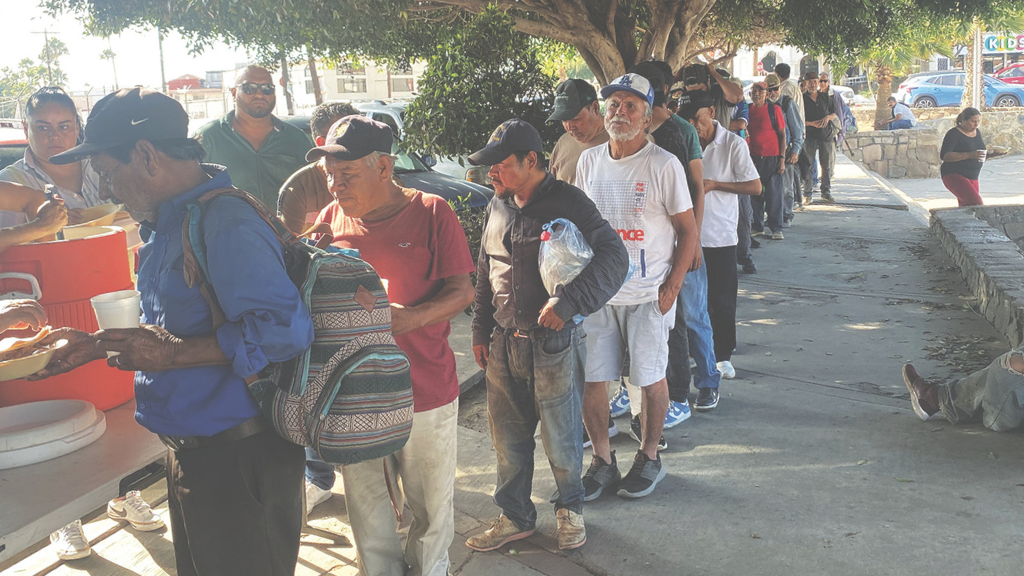
Rosa: Yes, of course. We visit the sick, and we invite families to worship with us. On Saturdays, we go to a large park in Enseñada to provide a meal to anyone who wants to come to us. Then, we hold a worship service after the meal. We ask people to share their needs and concerns, and we pray for them.
Jim: You do this every Saturday?
Rosa: Yes, every Saturday. We have seventy to eighty people join us. A few are addicts, some are sick, some are angry, but they all are forgotten souls, and we see them only as our brothers and sisters. We have been serving in the streets for over ten years. Since the new approach of the US government to immigrants, the great majority of people we see on Saturdays have been deported from the USA.
They are not originally from the Enseñada area. This is just where they are sent. They have no family here, no way to work, no place to stay, and no money. Some have been in America so long they don’t even speak Spanish.
In addition to the weekly meal and worship, we help in other ways. As we talk to the people, we learn about other needs, and we try to help with those, too. We help with transportation to rehab or other medical treatments. We help them get in touch with their families elsewhere in Mexico and then help with bus transportation to places where they can find a place to live. We help them get the documentation they need to work here in Mexico. We provide clothing when we can. This year we have a goal to give out 100 blankets when the weather turns colder.
Jim: This feels like a big commitment by your congregation. How do you manage it?
Rosa: Yes, it is. But we believe this is what we are called to do. God has put us in this place at this time, and this is our response to his call. We buy and cook all the food ourselves. We have four teams of eight people each. Each team takes one Saturday and divides up the cooking. Then, we have a couple of us who have cars, and we pick up the teams at their homes with the food they prepared and drive to the park in Enseñada.
Everyone in the congregation helps in some way. The seniors, the youth, even the children. We are praying that we will find another building so we can have a place to cook and serve a meal every day. We believe God will lead us.
Jim: Where do you get the money to support this?
Rosa: Our congregation gets some help from the mission center for our rent and other basic needs. But the funding for this ministry is supported by the generosity of our members. We spend about 1,000 pesos (about USD $55.00) a week on the meal and the other help we give the poor. If we don’t raise enough in our Sunday offering, then that week’s cooking team buys the rest of the food. All the other things—transportation, clothing, blankets, etc.—come from the personal generosity of our members.
Jim: How did the congregation decide to start this ministry of helping the poor and homeless?
Rosa: Because we look into our streets and we see them. How can we ignore them? Again, we believe that God put us here for this reason. This is our response to God’s love and mercy for us. We allow our hearts to be broken for them, as Jesus’s heart was broken for us. It is his love that we share. We are just his hands and feet.
Jim: Has this ministry affected your members?
Rosa: Of course. Our hearts are broken for the suffering we see. We realize that if we were not connected to the church, we might well find ourselves in the condition in which we find these other children of God.
We have become a community, a family, all working together. We share the love of Jesus together, and we are growing in mercy. We don’t just meet on Sunday to worship among ourselves. We go where God calls us.
Jim: If my congregation wanted to get more involved in helping meet the needs of our neighbors, what advice would you give?
Rosa: Well, I would say that you need to pray and listen to the Spirit. And be willing to let your hearts be broken. The type of work and ministry that we do is not easy. Staying grounded in the love of God gives us the courage to move out. God has led us to the park in Enseñada. God will lead you where you allow God to take you, too.
So we ended our call. Rosa hurried off to serve “the street people.” Michelle turned back to her workday that I had interrupted with my urgent need for translation help. And I, teary-eyed, thanked Rosa for the conviction that she and her congregation have about their calling to serve their Master.
And I started to hum the hymn, “Let Your Heart Be Broken.” It struck me that it is from the broken hearts of our brothers and sisters in El Sauzal that the love of God—in real and tangible ways—spills into a city park in Enseñada, Mexico, at 4:00 p.m. every Saturday.