
By Jim Ash
Human Rights Team lead
I opened the door to what looked to be a typical Sunday-school classroom, expecting to see a bulletin board with pictures depicting Bible stories and a table surrounded by small chairs.
Instead, the room was filled with shelving, packed with rolls of toilet paper, diapers, and personal- and household-hygiene items. This was the “necessities pantry” operated by the Colonial Hills Congregation in Blue Springs, Missouri, USA, and I had come to talk with Garland Land about this community ministry.
Jim: Garland, tell me a bit about the congregation.
Garland: We are in a suburb of Kansas City. We’re a relatively large group, averaging eighty to ninety folks on Sunday, with thirty or forty more joining online. Most are empty-nesters or senior citizens, but we also have some younger families and youth.
Jim: Tell me about the “necessities pantry” ministry. How did it start?
Garland: Well, we had been meeting in our fellowship hall for years, and ten to twelve years ago we built our sanctuary. When we did that, we consciously decided to be more outreaching in the community.
We didn’t want to duplicate what others were doing. We wanted to fill a gap.
We didn’t know exactly what we wanted to do, only that we wanted to do something. So, we invited several community-service organizations to talk to us to see if we could plug in. We didn’t want to duplicate what others were doing. We wanted to fill a gap.
A lot of churches and other organizations had food pantries or clothes closets, but we learned that only one church, several miles away, offered what’s called a “necessities pantry” for things like toilet paper, diapers, personal-hygiene products, and the like. Most people don’t realize that these can’t be bought with food stamps. We thought, well, nobody is doing that in our community, so maybe that’s a gap we could fill.
Jim: Wow! That sounds like a real need. How does it work?
Garland: We set up a relationship with Community Services League, a large nonprofit service organization headquartered in nearby Independence. We give it vouchers, and it refers people in need to us.
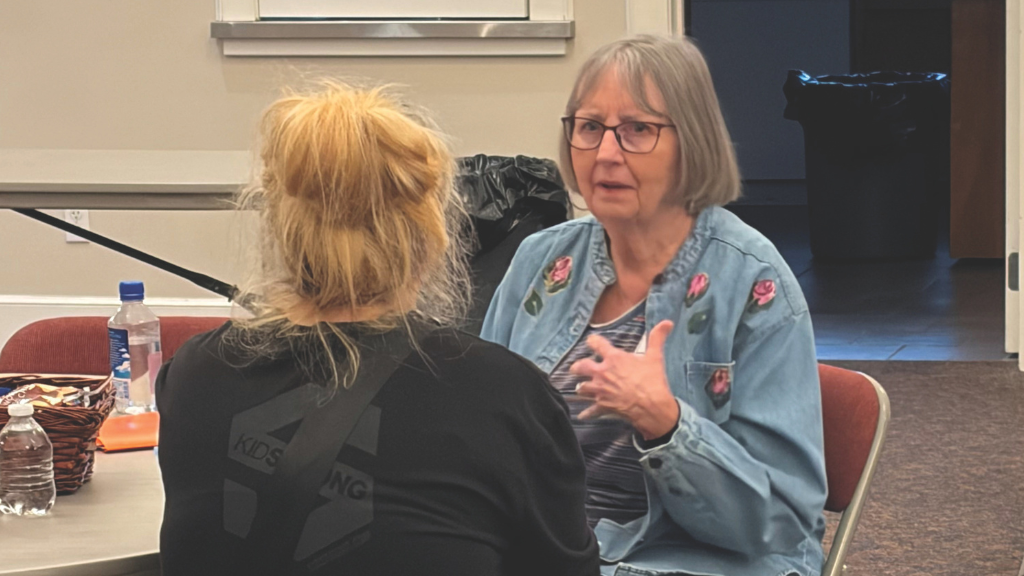
What we distribute is a huge help. But what really makes us different is that we want to connect with people who come in. When they arrive we invite them to sit with one of our members, and we just ask, “How are things going?” And they start telling their story, talking about where they are in life. Sometimes these conversations can last forty-five minutes and raise emotions of all sorts. This is as much a benefit to them as the items they came for. And we learn other ways we can help them.
Jim: What other kinds of things are you talking about?
Garland: Well, we have developed a pretty comprehensive list of other services in our area, so we usually can give them somewhere to get help beyond the necessities we provide. If they have a payday loan, we can refer them to a credit union for possible refinancing. We know where they can go to get glasses, medical help, a meal plan, etc. We have it all here on our form (a five-page, single-spaced array of services).
Jim: Was there any particular preparation, internally or externally, that you needed to go through?
Garland: Well, we went through the community-assessment effort I talked about. And wek need twenty to twenty-five people every time we open the pantry. We had to organize, assign roles, etc. And we had to commit two classrooms to store the products. Externally, we had to work with Community Services League to set up the voucher system.
Jim: You do this here in the church building?
Garland: Yes, the people come here. They register and fill out an application listing what items they want. Then they’re invited to visit with one of our members, to tell their story, and we learn if we can help them with anything else.
It’s not just the pantry; it’s the willingness to listen to the Spirit.
From that process we’ve kind of adopted some families. We had one family with five children living in their car. We adopted them for over a year, getting them into a motel. We’ve met four or five families now that just show up. We had a Haitian family that was just walking down the street and came in. No one here spoke French, but we figured it out. We helped them for several months before they moved to New York.
It’s not just the pantry; it’s the willingness to listen to the Spirit. We believe God is leading people here, and we are a congregation willing to respond to their needs. It’s just having a willing heart, not only with the pantry. When somebody comes in with a need, we’re willing to respond.
Jim: That raises a question. Where do the resources come from?
Garland: We get the baby diapers from a regional program called Happy Bottoms. We provide about fifteen other items that we buy at discount stores or wherever we can get the cheapest price. We have some money in our congregational budget, but most comes from donations by congregation members and friends.
Our biggest cost is car repairs. In our listening, we learned that one of the biggest needs was reliable transportation. People couldn’t get to work, the doctor, or whatever, because their car had broken down or wouldn’t pass licensing inspection.
So we developed a car-repair program. We found a mechanic, and we just asked, “If we refer people to you, will you set up an appointment for them, fix the car, and send us the bill?” We’ve been doing that the last couple of years.
Jim: What a blessing that is! But it can’t be free.
Garland: Well, it is to the car owner. But you’re right. We spent $25,000 on this last year. All the money for the pantry and the car repairs comes from congregation members, above and beyond a small budget allocation.
Jim: Were there any specific obstacles that at the beginning you needed to work through?
Garland: Nothing big. When you start a program, you always have to learn what’s working and what isn’t, and you need to adjust. An early adjustment was scheduling. We’re open twice a month, on a Tuesday afternoon and a Saturday morning. We assumed most people would come on Saturday morning, but it turns out most come Tuesday afternoon. So we had to rearrange staffing assignments.
Another assumption we “got wrong” was who would be coming. We thought our main need would be diapers for single mothers. But we learned the vast majority of people, probably as much as 80 percent, are elderly women. Their husbands have passed away, and they are living on one income and barely making it. They may be on food stamps, or they can go to other food pantries, but we’re the only place that provides “necessities” they can’t afford.
Jim: Did you need to do any specific training or orientation for the congregation volunteers?
Garland: We’ve done a bit. But, we just trusted our people. We’re not here to proselytize. If they want to pray, we will pray with them. And we’re not here to judge. We just want to listen, hear their story, show compassion.
Jim: I think some people will ask (maybe not out loud) whether you are concerned that people will take advantage of the congregation’s charity?
We’re not here to judge. We just want to listen, hear their story, show compassion.
Garland: Am I concerned, personally? No. Does it happen? Yes. I think it bothers some people if someone takes advantage. We put up our guardrails. We don’t just hand out money here and there. But we have been taken advantage of.
I worked with a family several years ago, bought them a car and trailer. And then one day, I never saw them again. Yeah, it stings a little. But, you know, if we’re not willing to take the risk, as our mission prayer says, then we’ll just sit comfortably in our pews and sing good songs and read nice prayers.
Jim: How has this ministry impacted the congregation?
Garland: You know, we hear in a lot of sermons that we should be outreaching. Our members know we are doing something, not just listening to the words. With the necessities pantry and the car-repair program, we identify that this is who we are as a congregation. We are a congregation involved in our community.
We know that when we hear about people in need we will respond as best we can. We know that for whatever reason, we’re not here to always “fix things.” We’re just here to love, show compassion. And whatever happens from that point on, we just leave in God’s hands.
Jim: If my congregation came to you and said, “We think we would like to get involved in something in our community,” what advice would you offer?
Garland: Well, I would say first, find out what other groups are doing to serve the community and look for gaps. Don’t spend energy duplicating what others are doing, and don’t let pride get in the way. Just because you want to do a particular thing doesn’t mean that’s what your community needs. Let the call to service lead you. Maybe the best thing you can do is help others with what they are doing, by adding capacity and support.
Second, inventory your congregation’s resources. What time, talent, and/or treasure do you have? Do you have active retirees? People with medical, counseling, or legal experience? Is there a capacity for additional financial support? When we first started we had no idea what we were going to do. We just knew we needed to be doing something.
Third, don’t “expect” anything. Don’t expect to get new members. Don’t expect that you will “fix” things. Just be willing to listen to the Spirit. Everyone has to figure out their own path.
The following Tuesday I stopped by to see the ministry in action. About twenty congregants were checking people in and filling bags of necessities from the classroom of shelves. But also, in the truest sense of service, they were sitting one-on-one with the folks who came in, listening with attention and compassion to their stories.
If you would like to know more about this ministry, contact Garland Land.
Share Your Story
This is the second in a series of articles celebrating what Community of Christ congregations around the church are doing in response to the call to develop congregations in mission. If your congregation has a story to share, contact the Human Rights Team.