
This is the fifth in a series of articles celebrating what Community of Christ congregations around the church are doing in response to the call to Experience Congregations in Mission. If your congregation has a story to share, contact Jim Ash.
The Holley-Navarre Congregation is in the panhandle of Florida, USA. The group has found some fun and unusual ways to engage the community. I hope you find this as interesting as I did in my conversation with Jamie Hawkins, the mission center co-president.
Jim: Jamie, tell me a little about the congregation.
Jamie: We are about twenty-five to thirty-five on any given Sunday. We have a nice distribution of people between the ages of thirteen and seventy. Our congregation sits in a neighborhood, surrounded by basically middle-class homes. Many of us are military families that work on local bases.
In addition to our church building and parking lot, we have probably several acres of wooded area next to our building. We also have a large lawn area. These spaces become important when we talk about two of our most successful community activities.
We've never tried to focus on the numbers; instead, we focus on using our resources to give the community something it needs.
Jim: Before we get to those, let’s talk a little bit about what your group does in the community.
Jamie: Sure. As a congregation, we have decided that we want to share the love of our Lord through helping meet needs in our community. We look around our community, try to identify some specific needs, and plan accordingly. We begin activities in February and end in December. Everyone in the congregation participates without complaint. It’s like something we just “do.” We have been doing large outreach activities for years, so everyone who becomes part of our congregation knows what they are getting into!
For instance, last Thanksgiving we decided to visit the local assisted-living facility with blankets and socks (needs identified by the staff there). The youth loved it and wanted to visit again at Christmas. Since then, our youth have initiated visits on every major holiday. Both our youth and the residents love it! Our youth even got permission from our pastor, Kathey Barnard, to contact the facility directly to set things up.
In addition, we sell fried-fish dinners and sponsor raffles to raise money for families in our community that have excessive medical bills or funeral expenses.
There is a community Christmas event in Navarre that includes a holiday run followed by a parade. Both the run and the parade go by the front of our church, so we staff tables along the street to provide water, protein bars, etc., for runners. Then, when the parade comes by later, we open our parking lot for people to bring their chairs and sit along the street to watch. And we hand out hot chocolate and snacks. We always have Santa there to greet the little ones.
All these activities give our members tangible ways to be inviting to our community and continue to unify our congregation in a common purpose. That comes back into our own congregational activities. On Sundays, in addition to our worship, the youth hold an online church school to stay connected with a couple of our new young members who have moved off to college.
This seems to be the best time for the kids’ schedules—no conflict with sports or school events—and it makes great sense for us to be flexible to meet their schedule. We also have potluck and Bible-story night on Wednesdays that all ages enjoy.
We’ve never tried to focus on the numbers; instead, we focus on using our resources to give the community something it needs. For us, we try to witness in the community rather than to the community.
That said, last year we had thirteen baptisms, and seven were between the ages of twelve and twenty. Very few were from families already affiliated or members of our church. Instead, most were introduced to our church by one of our younger members who invited his friends from school to his testimony service after he had completed chemotherapy following a cancer diagnosis. Many have continued to attend.
We formed sincere relationships with them, and we know what is happening in their lives. We love them dearly. They reach out to us when there is a need in their lives for prayer, a pickup from football practice, a flat tire, or anything. Close relationships are so very important in congregational life.
For us, we try to witness in the community rather than to the community.
Jim: That’s a wonderful story, and it reminds us that sometimes it just takes the courage to share our story.
OK, I know you’ve been itching to tell me about the two biggest community events you hold. Let’s start with Easter.
Jamie: Well, a few years ago we decided to add a community event to our Easter celebration. A lot of churches and other organizations hold egg hunts, which basically are plastic eggs or candy spread out on their lawn. It’s not much of a “hunt.” It’s more a “gathering.” We wanted to do something different and more fun for everyone. We have a couple of members who love to tinker, and they decided that an Easter-egg “launch” would be a lot more fun for the kids and parents, too.
I don’t completely understand the technology, but somehow they converted leaf blowers into plastic-egg launchers, much like the T-shirt launching machines you see at sporting events. They added one tube that is filled with plastic eggs. The eggs then drop into the blower tube and are launched into the air to be caught or retrieved by the kids.
It’s a huge amount of fun and brings quite a crowd. And while everyone is there, the congregation serves burgers and hot dogs. We recently added an “Easter Journey,” which is a trail set up with scenes commemorating the life and death of Christ for our guests to view.
Close relationships are so very important in congregational life.
Jim: That really does sound like a lot of fun and a bit more challenging for some of the older kids.
Jamie: Yes, and the parents have a wonderful time, too. I suppose some might say the Easter-egg launch is not in keeping with the religious aspects of Easter. But it brings families out together for fun and fellowship. And that is always a good thing.
Jim: OK, let’s move onto the main event. What happens to the Holley-Navarre Congregation on Halloween?
Jamie: That’s our biggest event of the year. We turn our property into a Fear Forest for the two weekends leading up to Halloween. We set up a path through the trees and brush with “spooky” characters and vignettes. This started as a rather small undertaking, but every year the haunted trail has grown longer and more exciting, and the crowds have grown tremendously. We attract people from miles around. Then, after Hurricane Michael, through a congregation member, we were in contact with a group called Feed the Gulf.
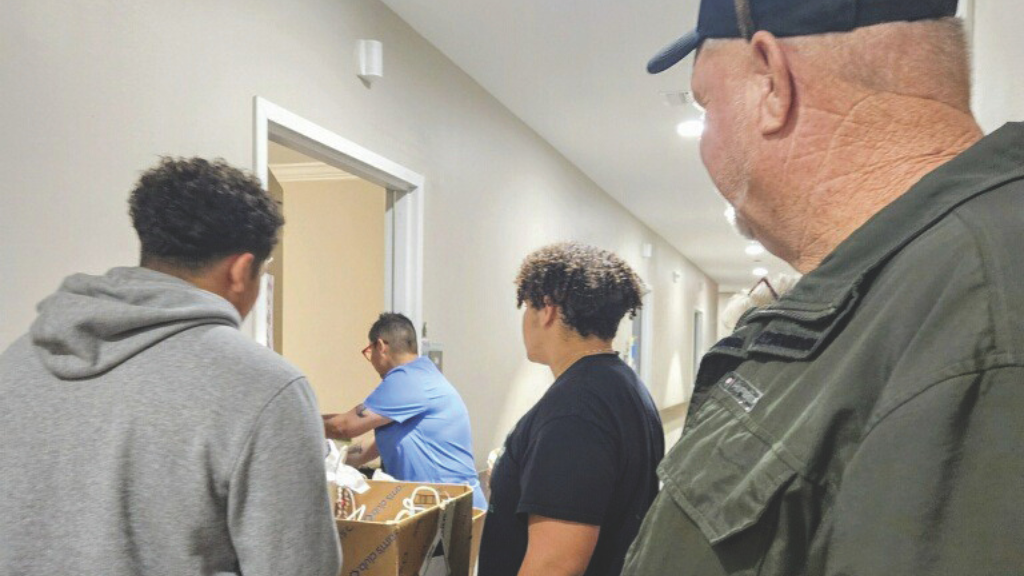
It told us about the serious need for nonperishable food items, so we decided to add a food drive to the Fear Forest. That allows the community to feel it is helping a good cause, since families of all socioeconomic backgrounds can participate. Last year our food donations went specifically to military families on furlough. Members of the community stop by and even donate during the day by placing items in large containers in front of the church.
Jim: While it may not be everyone’s cup of tea, it does sound fun. And I’m sure it attracts a lot of youth who otherwise might find the “trick” part of Halloween enticing.
It's a huge amount of fun and brings quite a crowd.
Jamie: I’m not sure you understand the scope of what I’m talking about. Last year more than 6,000 people visited our Fear Forest. There’s no charge, but we do ask that people bring an item of food that we can provide to pantries. Those 6,000 people brought more than 3,000 pounds of food!
When it first started, we opened the church for bathroom use and provided water and snacks to people as they waited their turn to go through the trail. Well, hosting 6,000 people has changed things quite a bit. We now see the waiting line stretching for blocks. And, of course, now we bring in portable toilets to prevent a strain on our septic system!
We greet each person, talk about our congregation, hand out church pamphlets, and generally keep them entertained with videos created by one of our members that also highlight local sponsors.
Most importantly, we help our neighbors meet one another. I hope I am not jinxing us, but amazingly, the neighbors in the subdivision surrounding the church never complain about the massive traffic overload on the neighborhood, and they allow visitors to park in the street in front of their homes.
Every year the congregation expands the trail and adds new and different parts. Everyone in town knows about our Fear Forest. Again, like the Easter-egg launch, some may question having our congregation known in the area for a haunted trail and Fear Forest. But we feel that providing a structured, supervised, and free event for families for the two weekends leading up to Halloween is a real community service. And I guess 6,000 people can’t all be wrong!
When you give to your community, it will give back to you.
Jim: Besides the thousands of people coming to the church on Halloween, have you seen other community responses to the church outreach?
Jamie: Absolutely. Here’s a great example. We needed a new heating and cooling system for the church. We went to a company, not connected with the church in any way, to buy a new unit. We were quoted a price of over $10,000.
That is a lot of money for our small group, but it seemed reasonable, so we decided to move forward. But, when the owner realized it was for our church, he donated the entire $10,000 system and all the installation labor costs! He said it was because we “were always doing things for the people in the community.” That was so humbling. But it also confirmed that we are on the right track: When you give to your community, it will give back to you.
So, flying Easter eggs and ghouls in a spooky forest may not work everywhere. But for a small, dedicated group on the Florida panhandle, just steps from the Gulf, events like those bring them over 6,000 visitors a year and collect 3,000 pounds of food. They also reaffirm a consistent theme in congregations: Offer something to bring the community together, and people will respond.