
By James Ash, Human Rights Team lead
Just after the Christmas holidays, I visited with Don and Glenda Millard and their son, Todd Millard, who attend the St. Thomas Congregation in southern Ontario, Canada. It was a free-flowing group conversation. In their excitement to talk about everything happening at St. Thomas, each had several comments or points. These answers are compilations of their individual comments.
Jim: Tell me a little about the St. Thomas Congregation and its surrounding neighborhood.
Answer: Our congregation is about forty to fifty in number on any given Sunday. We range in age from under ten to over ninety. But not too many years ago there were discussions about selling our building and moving to a smaller building.
The church sits in a residential part of town, and we are at sort of a socio-economic crossroads. In one direction, there are middle- to upper-middle-class homes. In the other direction, there is income-assisted housing and areas of homelessness.
Jim: I have heard about the $2.00 dinners the congregation puts on. Tell me how those came to be.
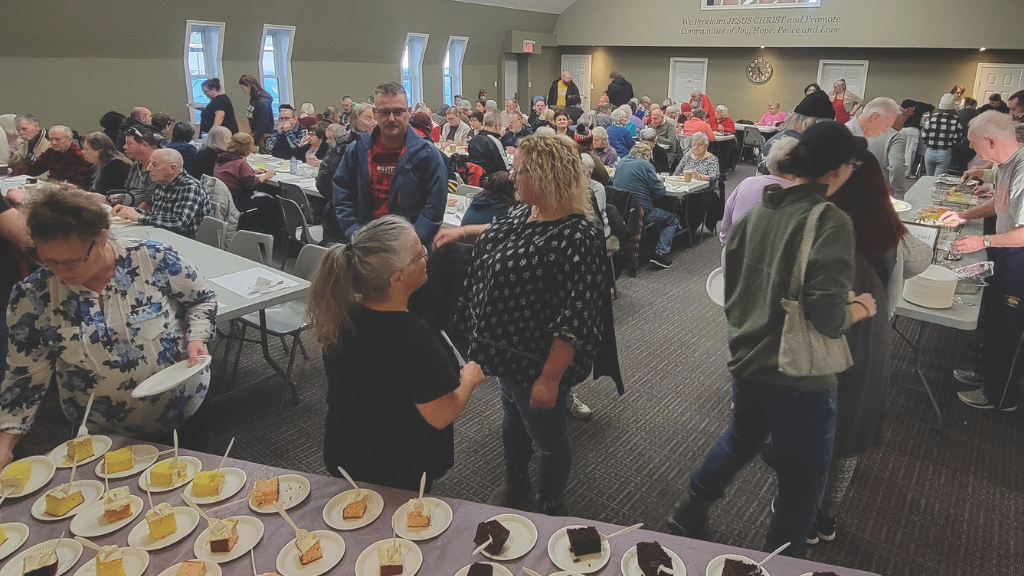
Answer: Well, they started when we were attending the Brydges Street Congregation in London. The idea is to give the neighborhood a community activity that everyone can attend. And who can resist a wonderful, all-you-can-eat beef, ham, potatoes, carrots, coleslaw, dessert, etc., dinner at that price? We wanted people in the neighborhood to get to know each other, to meet others they otherwise might not visit with.
We had been attending St. Thomas but transferred to Brydges Street in London about 2002. Todd and his family returned to St. Thomas before us, and as I mentioned, there was talk of selling the building. Around 2018 we came back here, and we sort of brought the idea of the $2.00 dinner with us.
At first the dinners were small, fifty to sixty people. But as time passed and word spread, attendance grew. Now we serve as many as 370 people in three hours on one Saturday evening every quarter! We advertise on social media and, of course, by word of mouth.
...the idea was never that this was a fundraiser or something the church gave the community. It was always intended to be a community event.
Jim: That sounds amazing! How do you manage with your relatively small group?
Answer: Well, that’s the thing. As word spread, the dinners grew, and people came from all over our small city, some walking from their subsidized apartments and some driving up in their Mercedes. And as the dinners grew, people wanted to help. They wanted to be part of what was happening at the “church on the hill.”
We need thirty to forty people to cook, serve, and clean, and about half are volunteers from the neighborhood. Many people donate more than the $2.00 charge, too.
See, the idea was never that this was a fundraiser or something the church gave the community. It was always intended to be a community event. A time for people to meet and get to know neighbors, to form a true community in which our church is just one part. We want everyone to feel welcome and have fun.
Jim: So, the idea is for the congregation to be a resource, an active participant in its neighborhood and city, rather than just a Sunday-morning visitor?
Answer: Exactly. The $2.00 dinners are just one very successful part of that. They have become a mainstay in the neighborhood. People look forward to them. For some, it is the only dinner out they can afford. For some, it is the only hot meal they may have for several days. And for some, it has become their way to give to others.
Jim: Again, this sounds amazing, but it must put a financial burden on a small congregation. How do you manage the costs? And not just the food, but the kitchen equipment must be expensive, too.
Answer: Well, we shop as smartly as we can, of course. But if you focus on the cost, you are missing the point. You don’t serve others to make money. You serve others because you want to serve, and they need to be served. Some people can’t afford even the $2.00, and some people make goodwill offerings of $20, $30, $100. We have never lost one dollar on a dinner, but if we never made a dollar, that would be OK, too.
And yes, as the size of the dinner has grown, we have had to “institutionalize” our kitchen. Much of that has come from donations. After the passing of a couple of our members, one surviving spouse donated a huge refrigerator, and another surviving spouse donated a large freezer in their memories. This freed up funds in our building fund, and with some additional donations we were able to buy a new stove and a commercial dishwasher. No more paper plates and plastic forks. We serve the meal on real plates and flatware!
You don’t serve others to make money. You serve others because you want to serve, and they need to be served.
Jim: All the beef, ham, coleslaw, cabbage, carrots, corn, potatoes and gravy, pickles, bread, and cake you can eat, on plates and flatware, for $2.00. No wonder you pack the place!
Answer: That’s not all. We have community groups ask us to “cater” their dinner events, too! They always ask how much we will charge, and we give them the same answer: “We don’t charge. Donate whatever you think is right.” We don’t do it for the money, we do it to be a good neighbor.
Not everything we do in the community is about food. We open our building to groups and neighbors as often as we can. We have a seniors yoga group that meets once a week, a coin club that meets every month, a stamp club that meets twice a month, and two TOPS groups that meet weekly.
The coin club asks us to cater its annual holiday dinner, and it chooses to pay us by the plate, just like any other caterer. The stamp club hosts the annual provincial-wide Ontario stamp fair and asks us to provide breakfast and lunch at a nominal price. Over time, all of these groups have come to support other community services we provide. They attend our dinners and donate to our other outreach activities.
Jim: What are some of those other community services?
Answer: We host a Christmas bazaar in November, when we rent tables for people to sell gifts, toys, crafts, etc. A lot of our neighbors do their Christmas shopping there. There is a huge selection of homemade holiday baked goods and a silent auction, too.
I mentioned the income-assisted housing down the street. We have really formed a connection with those neighbors. We all get together at Easter, Thanksgiving, and Christmas for a potluck dinner. We bring the turkey and ham, and everyone attending brings a dish. It’s not giving them dinner; it’s more like a family holiday get-together. Everybody shares. And, every year at Christmas we provide each child who lives there a new pair of pajamas.
We don’t see these as “our events.” They are neighborhood events using our building.
Every summer we host a neighborhood-wide yard sale, where neighbors can set up a table, spread out a blanket, or use the trunk of their car to sell their “wares”—things they don’t need, crafts, whatever. This brings a big crowd, and we support it by selling hot dogs, hamburgers, ice cream, cake, and strawberries. It has become so popular now that people have to reserve their spot!
And in March we have an “indoor yard sale” to beat the weather, accompanied with breakfast and lunch. We don’t see these as “our events.” They are neighborhood events using our building. Even what started as our annual congregation chili cook-off has now broadened to include the neighborhood. In fact, the last two winners have been neighbors!
Jim: It sounds like the congregation building has become a sort of community center for the neighborhood.
Answer: Well, maybe a better word would be community facility. We invite people to dinner, we open our “home” to them for meetings, we even have neighbors hold birthday parties and family dinners here.
Jim: From the sound of it, your building must be in use by some outside group several times a week. How do you manage the logistics? Who “mans the door?”
Answer: Well, each group signs a “use agreement” that says what rooms they will use, how to clean and set up the areas when they leave, and then we just give them a key.
Jim: Wait, you just give them keys?
Answer: Sure, they’re our neighbors. We trust them, and we have never been disappointed.
Jim: You said earlier that just a few years ago there was talk about downsizing the church. There seems to have been quite a turnaround.
Answer: We’re glad you asked. We decided as a congregation that we wanted to build a “community service” mindset in the city. We started with the $2.00 dinner as a catalyst to forming that community.
It seems that a lot of people want to live the gospel a bit more than they want to hear sermons about it.
Then, as that took hold and other service opportunities arose, we began to share testimonies about the fun we were having and the joy our involvement in the city brought. We saw a cycle develop. The more we got involved with our neighbors and community, the more fun we had. The more fun and joy we experienced, the more we felt the Spirit bless us and the neighborhood. The more that blessing came, the more we and our neighbors wanted to join in community.
Long-inactive members have come to a dinner, received a warm welcome, reconnected with friends, and re-engaged with their church. Our Sunday worship often focuses on the joy of giving, service, and “connection,” and that just makes us want to do more!
Neighbor friends who never set foot in a church now are regular and active attenders, having found a group that offers an opportunity to enjoy the fun and fellowship of service. It seems that a lot of people want to live the gospel a bit more than they want to hear sermons about it.
But let’s be clear. We don’t do what we do as fundraisers. We don’t do what we do to fill pews. We do it to create a community, to be a good neighbor, and to get our neighbors to know and support each other. Anyone who wants to join in that is welcome, whether we see them every Sunday morning or four Saturdays a year, peeling potatoes and carrots. Meeting Sundays in-person is important to us. Worship is part of our community. But, even in our services, we laugh and make our time together fun.
It was after 11:30 at night when we ended our call, and I had the distinct impression that Don, Glenda, and Todd could have kept talking until the sun rose about all the ways the St. Thomas Congregation is being a good neighbor. Much of what they do involves food (never a bad idea!), but they also might have found the right recipe for creating true community: Mix one part food, one part fellowship, and one part service, and then add a liberal portion of fun!