
By Jane Gardner
Formation Ministries Team
Alleluia!
This expression of praise has evolved throughout centuries of liturgy. It is a Latin form of Hallelujah—an acclamation that joins “Hallelu” (to praise) with the first syllable of the Hebrew name for God, Yahweh. Often, alleluias were sung before and following the reading of the psalms. Within the wider Christian tradition, alleluias typically are not sung during the forty days of Lent and then are reintroduced during the Easter season. In Revelation 19:6–7 NRSVue, the praise emphasis is summed up:
Then I heard what seemed to be the voice of a great multitude, like the sound of many waters and like the sound of mighty thunderpeals, crying out,
“Hallelujah!
For the Lord God
the Almighty reigns.
Let us rejoice and exult
and give him the glory...”
With widespread biblical use, it is unsurprising that one of the most published ancient Easter hymn texts repeats “alleluia” at the end of each line:
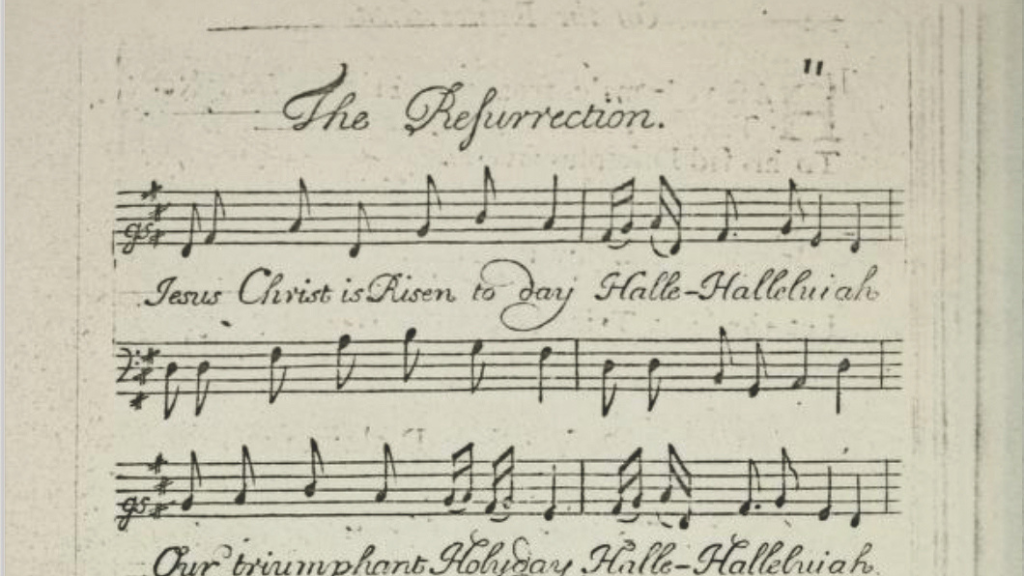
Jesus Christ is risen today, Alleluia!
Our triumphant holy day, Alleluia!
Who did once upon the cross, Alleluia!
Suffer to redeem our loss, Alleluia!
This hymn, strongly identified with Easter, was developed by an unknown author in the fourteenth century in Latin with eleven stanzas titled “Surrexit Christus hodie.” It was translated into English in 1708 by John Baptist Walsh in his Lyra Davidica (Collection of Divine Songs and Hymns). Initially the hymn had only three stanzas translated, with just the first verse being a direct translation.
This small book contained thirty to forty hymns or canticles, the most famous being “Jesus Christ Is Risen Today.” It is an unusual collection for its time for two reasons. First, in addition to the printed texts, it has music interlined with the words handwritten above the notes. Second, the choice of hymns is very different from other books of the time. The music was designed to be freer and more demonstrative than the grave and serious psalm tunes.
Included in the text is a narrative of the events of the resurrection, including the discovery of the empty tomb by the women, the announcement of the angel, and the women’s report to the other disciples. The last stanza concludes by praising, blessing, and rejoicing in the resurrection.
The tune, EASTER HYMN, probably of English origin, is lively and festive. The Musical Times reported in July 1914 that the melody of EASTER HYMN had been discovered in a hymnbook dating from 1684. EASTER HYMN now is one of the best-known and most joyous Easter tunes.
This hymn is to be sung with energy and conviction. Use brass! Use bells of all shapes and sizes to ring in the alleluias to help us recall that the bells silenced during a somber Lenten season now declare the joy of resurrection.
Alleluia!