
By The First Presidency
As a follow-up to our introduction of the global-farm metaphor in the March-April issue, this article outlines the specific elements of our shared work. The First Presidency introduced this image to answer frequently asked questions about how our identity, mission, message, and beliefs fit together across diverse contexts.
While the last article introduced the Global Farm as a unifying theological foundation and missional framework, this piece features a comprehensive introduction to the metaphor.
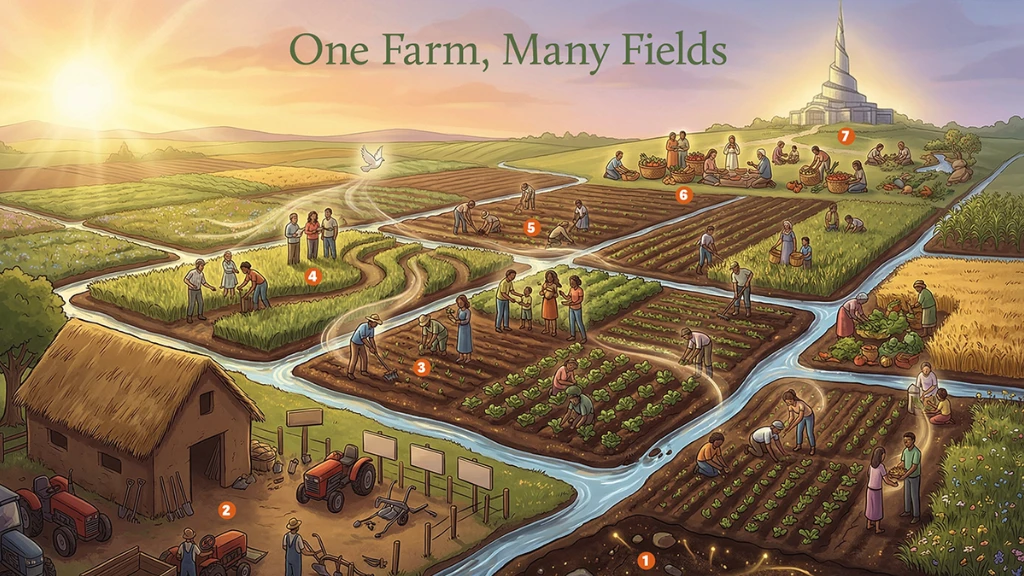
This includes a diagram that shows how our identity and diversity hold together in a single vision. Imagine Community of Christ as a vast, living farm in various places around the world. We are not just an organization; we are cultivating and harvesting God’s peaceable kingdom one season at a time.
1. The Soil: Ministry Context
Our foundation is the soil, which is the context of our ministry. We fertilize the soil by adding nutrients such as our Basic Beliefs and Enduring Principles. Without these nutrients, nothing we plant will grow strong. We keep this soil fertile by relying on the peace of Jesus Christ as the Light, and the scriptures as the water, which we hold in common with other people.
2. The Tools: Our Resources
In our barn, we have equipment to work the ground. We have tractors, plows, combines, and spades—these represent tools that help shape our identity as disciples. These tools include our name, sacred story, priesthood, sacraments, worship, and Christian education. We know that not all formation resources are available in all languages and places. However, as we expand access, these tools help us more fully work the ground and support the crops.
3. The Methods: What We Do (Mission Initiatives)
If the soil nutrients represent who we are, the five Mission Initiatives represent what we do. They are our farming methods—the specific ways we toil, till, and tend the field. We do not scatter seeds randomly; we live Christ’s mission in specific ways. With the guidance of the Holy Spirit, this labor turns the potential of the seeds into harvest.
4. The Crops: Our Strategies and Goals (2025–2028)
The field mission strategies and goals of each team are the crops. The World Church Leadership Council’s Shared Understandings guide us on what needs to be planted for this specific farming period. Here is our strategic focus for 2025–2028:
- Lead through Discernment and Agility: Make discernment the primary leadership practice for shaping vision, while implementing ways to evaluate faithfulness and maintain flexibility in a changing world.
- Develop Leaders and Empower New Voices: Boost leadership development across the church, specifically empowering emerging leaders and younger generations to influence the church’s purpose.
- Focus on Grassroots and Contextual Mission: Shift support toward grassroots initiatives, embracing identity, mission, message, and beliefs (IMMB) in local contexts.
- Nurture the Soul and Share Christ’s Peace: Deepen global connections and embody the soul of Community of Christ through the incarnation of the purposes of the Temple.
- Expand Stewardship and Sustainability: Develop true capacity for generosity while diversifying income sources to support global mission.
- Selection: When a team sets a goal, it is selecting specific seeds to plant.
- Technique: Teams often use “three-sister farming” or other techniques, planting complementary goals that grow together, rather than one item at a time.
- Care: Throughout the year, we faithfully nurture, water, and weed these specific goals.
5. Context and Experiments: Different Soil, Same Nutrients and Sources
A wise farmer knows you cannot force the same crop to grow in every climate, illustrating the contextualization of mission. A wise farmer also knows when fields need to rest to renew the soil and when experimenting opens new methods and opportunities for growth.
A field in one nation might plant “rice”—a specific cultural expression of the church. A field in another nation might plant “wheat.” Fields will experiment with different ways to create communities, looking for what yields the greatest harvest. Though they look different on the surface, they are grown from the same nutrients (Basic Beliefs and Enduring Principles) and nurtured by the same sources (Christ and scriptures) to feed the people in that specific context.
6. Stewardship: Sustaining the Farm
To keep the farm running, we rely on whole-life stewardship, our response to God’s grace. We practice tithing—giving generously to our true capacity. When we tithe our time, talent, treasure, and testimony, we support local and worldwide ministries that increase the harvest.
7. The Harvest and the Vision
We farm to fulfill a vision of healed people, reconciled communities, and restored creation.
- The Harvest: When goals are achieved, we harvest crops that feed the church and the world, moving us closer to God’s vision.
- The Temple: The Temple stands as a life-giving symbol, reminding us of this vision. It points us toward our true calling: to be a household where all feel at home—one that unites, heals, and restores.
By tending the soil, using our methods, and harvesting our crops, we move closer to creating new communities of healed people, reconciled communities, and restored creation based on God’s vision of shalom, where we live and serve. Ultimately, this framework is designed to help everyone find their place in the bigger picture. Whether you are enriching the soil or tending a specific crop in your congregation, you can see how your labor combines with the harvest of others around the world to move us all closer to God’s vision of shalom.